The Absurdist Abyss: Finding Meaning in 3-Headed Shark Attack's Existential Chomp
Exploring how even the most critically panned films, like 3-Headed Shark Attack, can provoke thought on chaos, survival, and the absurd nature of existence.

“The world is absurd, and he who is truly alive accepts its absurdity. He does not try to escape it, but faces it.” — Albert Camus
Let’s be honest right from the jump: 3-Headed Shark Attack (2015), directed by Christopher Ray, isn’t going to be gracing any “Greatest Films of All Time” lists. With a dismal 18% audience score on Rotten Tomatoes and a 2.7/10 on IMDb, its reputation precedes it, often whispered with a mix of bemusement and outright derision. Critics, where they bothered to review it, largely lambasted its paper-thin plot, the wooden performances, and CGI that, let’s just say, aims for “ambitious” and lands squarely in “cartoonish.” Yet, even in its profound imperfection, in its unapologetic embrace of B-movie schlock, there’s a strange, almost accidental philosophical resonance. What does a film about a mutated, multi-headed apex predator attacking a cruise ship tell us about the human condition, our anxieties, and the very nature of existence? Perhaps more than we’d care to admit.
The Absurdist Horror of the Multi-Headed Beast
The premise of 3-Headed Shark Attack is, by definition, absurdist. It takes a creature already established as a primal fear — the shark — and escalates it to a monstrous, illogical degree. We’re not just dealing with one set of jaws, but three, and eventually, the film’s logic (or lack thereof) even allows for a fourth and fifth head in its sequels. This relentless escalation, often played out with hilariously poor visual effects, immediately positions the film outside the realm of serious, realistic horror. But this is precisely where its accidental philosophical weight begins to surface.
Consider the existential threat posed by such a creature. It’s not just a danger; it’s an unreasonable danger. There’s no scientific explanation, no rational way to comprehend or combat it. It simply is. This mirrors the absurd, often senseless challenges life throws our way—illness, disaster, random acts of cruelty. The characters in 3-Headed Shark Attack are confronted with an enemy that defies logic, much like we, in our own lives, face situations that make no sense, that are inherently unfair. Their struggle, however clumsily depicted, becomes a microcosm of humanity’s Sisyphean task: to find a way to survive, or at least endure, in a universe that often feels indifferent, if not actively hostile, to our existence. The movie’s critics often pointed to the lack of realism and logical progression, but perhaps that is the point, albeit an unintended one. The chaos is the message.
- The Overwhelm: A single-headed shark is terrifying; three heads represent an insurmountable, chaotic force.
- The Illogic of Threat: The monster’s existence defies reason, mirroring life’s inexplicable hardships.
- The Struggle for Meaning: How do you fight something so absurd? With equally absurd, desperate measures.
 A desperate struggle against an impossible foe, reflecting humanity’s endless fight against the absurd.
The Spectacle of the Unspeakable – And Our Gaze
While the consensus among audiences and critics alike is that 3-Headed Shark Attack is a deeply flawed film – with common criticisms revolving around the laughably bad CGI, the stilted dialogue that often feels ad-libbed, and performances that range from wooden to wildly over-the-top – its enduring presence in the B-movie canon begs a deeper question: why do we watch? Why do we, as an audience, gravitate towards these spectacles of low-budget, high-concept chaos?
The appeal of the ‘bad film’ isn’t just ironic enjoyment; it’s a primal fascination with the limits of our control, a safe space to witness chaos without true consequence.
Perhaps it’s a form of catharsis. In a world increasingly complex and often terrifying in its real threats, there’s a strange comfort in watching a clearly artificial, ridiculous danger unfold. We can mock the effects, groan at the dialogue, and predict every predictable kill, but we’re still engaging with a narrative of survival against monstrous odds. It’s a low-stakes engagement with high-stakes themes. The film’s weaknesses become its strengths in this regard; its inability to genuinely frighten us frees us to ponder the underlying themes of vulnerability, resourcefulness, and the human drive to persist, however futile it may seem. Even Danny Trejo’s brief, iconic appearance feels less like a serious acting turn and more like an acknowledgment of the film’s self-aware, genre-bending absurdity. We’re drawn to the spectacle, not for its quality, but for what it allows us to project onto it—our own anxieties, our desire for simple resolutions, and our capacity for finding entertainment in the utterly preposterous.
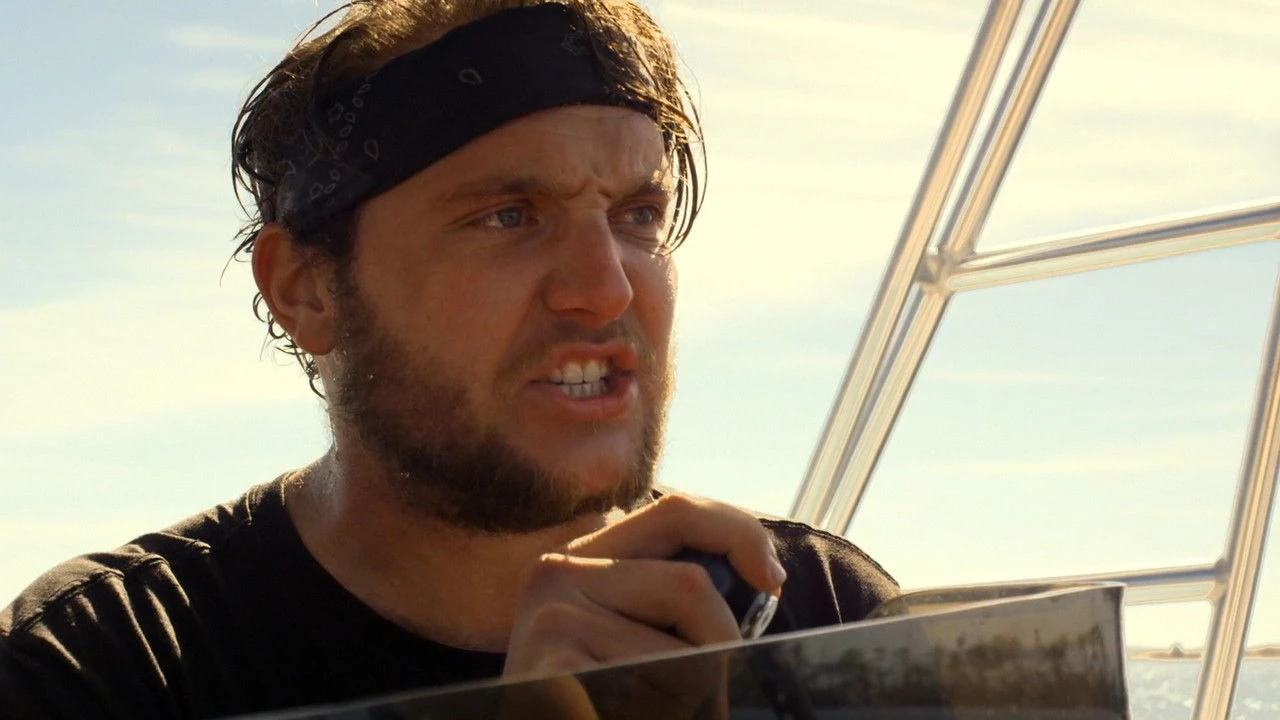 The film’s low-budget effects paradoxically highlight the raw, unpolished nature of its existential struggle.
Beyond the Chomp: The Philosophy of Survival in the Absurd
Despite its evident cinematic shortcomings, 3-Headed Shark Attack inadvertently taps into profound questions about human resilience and the search for meaning when confronted with the utterly nonsensical. The characters, a motley crew of researchers, tourists, and crew members aboard a research vessel, are stripped of their societal roles and forced to confront their primal instincts. Their “fight or flight” responses become absurdly literal against a multi-headed monster.
What does it mean to survive when your attacker is a biological impossibility? It forces a re-evaluation of what victory even looks like. Is it killing the shark, or simply lasting another hour? This isn’t just a monster movie; it’s a parable for living in a world where the rules are often arbitrary and the threats overwhelming. The film, in its own clumsy way, asks: when faced with an existential threat that defies logic and reason, do we succumb to despair, or do we improvise, adapt, and find a way to keep fighting, even if our weapons are makeshift and our plans are desperate? The movie’s exploration of group dynamics—the petty squabbles, the moments of heroic sacrifice, the sheer panic—while often poorly acted, still speaks to a deeper truth about how humans behave under extreme duress. It’s an exploration of nihilism confronted by an inherent, if sometimes clumsy, will to live.
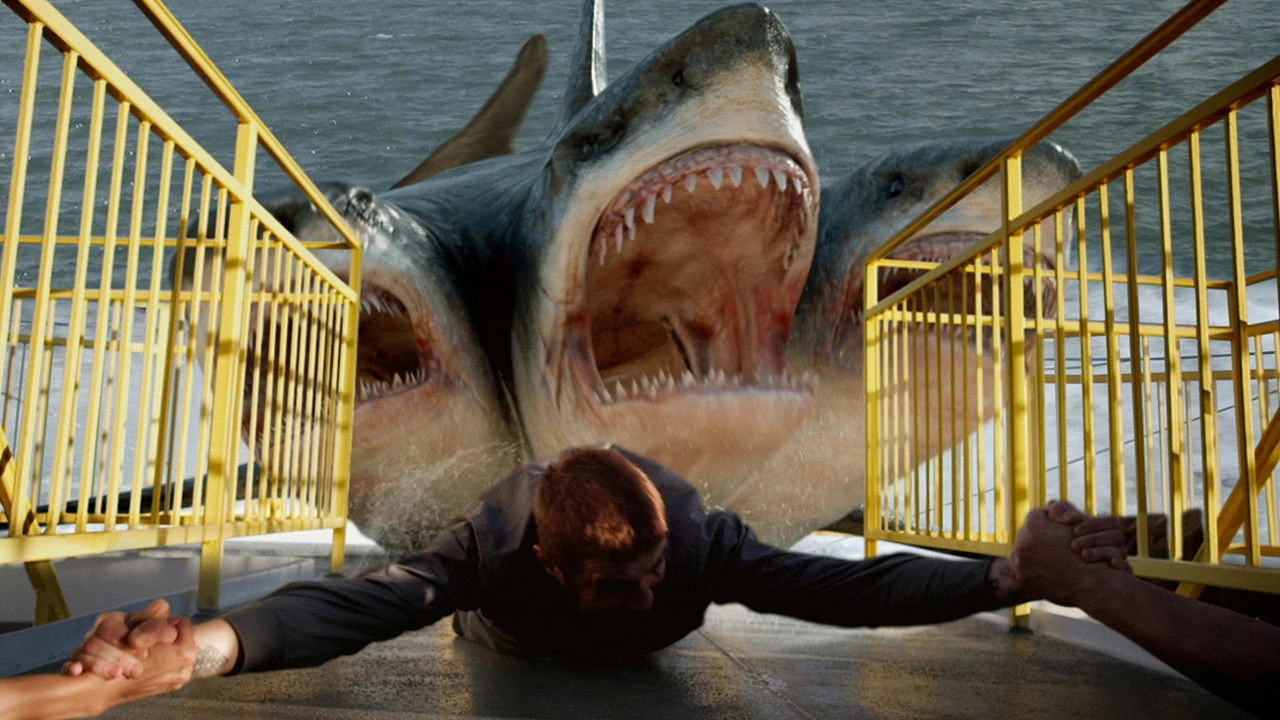 Amidst the chaos, the human element of fear and determination shines through, however briefly.
“The only way to deal with an unfree world is to become so absolutely free that your very existence is an act of rebellion.” — Albert Camus
3-Headed Shark Attack will never be hailed as a masterpiece of cinema, nor should it be. Its weaknesses are undeniable, its production values minimal, and its narrative often incoherent. Yet, to dismiss it entirely would be to miss an opportunity for philosophical reflection. In its deliberate, almost defiant embrace of the absurd, it holds up a funhouse mirror to our anxieties about chaos, our fascination with the monstrous, and our enduring, often clumsy, struggle for survival in a world that rarely makes sense. It reminds us that even in the most unlikely and critically panned corners of popular culture, profound questions about existence, resilience, and the human spirit can unexpectedly surface. What does our own engagement with such films, whether in jest or genuine fascination, say about our need to confront and conquer the absurd?
Where to Watch
- Philo
- Screambox Amazon Channel
- FlixFling
- Bloodstream
What’s Up? explores the philosophical depths of cinema.