Bugonia's Unseen Truths: Decoding Lanthimos's Looming Paranoia
Anticipating Bugonia (2025), this post explores how Yorgos Lanthimos's new film may dissect modern paranoia, conspiracy, and the human need for an alien other.

“The truth, we are repeatedly told, is out there. But what if it’s not ‘out there,’ but rather, a desperate construct within us, a defense against the chaotic void?” — Unknown
As we stand on the precipice of Bugonia’s (2025) release, Yorgos Lanthimos, the maestro of the wonderfully strange and unsettling, once again beckons us into his meticulously crafted, often absurd, and always thought-provoking cinematic universe. With a premise that sounds like a fever dream born from late-night internet dives – two conspiracy-obsessed young men convinced a high-powered CEO is an alien bent on Earth’s destruction – Bugonia promises a dive into the deep end of modern anxieties. Given the film’s unreleased status, our discussion here is necessarily speculative, an anticipatory philosophical unpacking based on Lanthimos’s distinctive oeuvre and the tantalizing synopsis. Yet, even in this pre-release contemplation, the film’s potential to dissect our contemporary relationship with truth, power, and paranoia is abundantly clear.
The Delusions We Cling To: Reality vs. The Narrative
Lanthimos has always been fascinated by the arbitrary rules and constructed realities humans inhabit, often pushing them to their breaking point. From the literal matching of partners in The Lobster to the societal expectations of Poor Things, his worlds are hyper-real, yet subtly off-kilter, mirroring our own subconscious absurdities. Bugonia, with its blend of Comedy, Crime, Sci-Fi, and Thriller, seems poised to take this fascination to an extreme, exploring how readily we succumb to compelling narratives, regardless of their factual basis.
The film’s core conflict hinges on a profound epistemological question: what constitutes truth, and how do we discern it from delusion? Our protagonists aren’t merely mistaken; they are convinced. This conviction, often born from a cocktail of fear, misinformation, and a desperate search for meaning in a chaotic world, is a hallmark of the conspiracy theory phenomenon. The CEO isn’t just a powerful executive; she must be an alien. This isn’t just about ‘them’ versus ‘us’; it’s about the very structure of belief.
Key themes we can expect Lanthimos to explore:
- Confirmation bias — the human tendency to seek out and interpret information that confirms one’s existing beliefs.
- The seductive power of narrative — how elaborate stories, even outlandish ones, can provide a comforting structure to complex, frightening realities.
- Social alienation and connection — the bond forged between the two young men through their shared delusion, contrasting with their isolation from mainstream reality.
- Authority and suspicion — the automatic distrust of power figures, amplified by the alien conspiracy.
 A lone figure in a desolate landscape, perhaps contemplating the vastness of the unknown or the isolation of their own beliefs.
Lanthimos’s Absurdist Mirror: Potential for Triumph and Tribulation
Lanthimos’s films are rarely universally adored; they are, by design, often divisive. His signature deadpan dialogue, unsettlingly sterile aesthetics, and often bleak humor challenge conventional cinematic tastes. Critics and audiences alike have, in the past, lauded his unique vision as groundbreaking while others have found it cold, pretentious, or simply too weird. Bugonia is unlikely to deviate from this pattern.
One might anticipate that the very elements that make a Lanthimos film brilliant – the detached performances, the precise framing, the slow-burn tension – could also be points of contention. Given his track record, it’s easy to imagine critics being split: some praising the film’s audacious satire and profound commentary, others lamenting a perceived lack of emotional warmth or a pace that might feel deliberately ponderous for its 118-minute runtime. The casting of Emma Stone, a frequent Lanthimos collaborator known for embracing his unique style, alongside Jesse Plemons, celebrated for his nuanced portrayals of complex characters, promises compelling performances. Yet, even brilliant actors working within Lanthimos’s framework can be perceived as stylized to the point of unreality by some viewers.
Lanthimos forces us to confront the uncomfortable laughter that bubbles up when our deepest fears are rendered absurd, a laughter that often masks a chilling recognition.
The genre cocktail itself – comedy, crime, sci-fi, thriller – suggests a tightrope walk that Lanthimos excels at, but which can also alienate segments of the audience expecting a more straightforward genre exercise. His sci-fi elements are typically less about spectacle and more about setting up allegories for human behavior, which might frustrate those seeking conventional thrills. The crime aspect will likely be less a procedural and more a vehicle for exploring the bizarre logic of its perpetrators.
 A close-up, revealing subtle expressions of bewilderment or conviction, hinting at the film’s psychological depth.
The Alien Within: A Metaphor for Modern Anxiety
Beyond the literal plot, Bugonia offers fertile ground for metaphysical and existential exploration. The “alien” CEO isn’t just a sci-fi trope; she embodies our collective anxieties about power, control, and the opaque nature of global capitalism. Who really runs the world? What are their true intentions? These questions, which often fuel real-world conspiracy theories, are brought to the forefront through Lanthimos’s lens. The alien becomes a potent metaphor for everything we fear but cannot fully grasp: climate change, economic inequality, the sheer scale of corporate influence.
The idea of “destroying planet Earth” takes on a chilling resonance in our current era of environmental crisis. Is the CEO truly an alien, or is she merely a stand-in for the indifferent forces of human industry and consumption that seem to be doing precisely that? This narrative provides a convenient, externalized enemy, preventing us from looking inward at our own complicity or collective failings.
Lanthimos’s work frequently exposes the fragility of human dignity and the bizarre ways we cope with our own insignificance. The young men, convinced they are saving the world, are perhaps just seeking meaning, a sense of purpose in a world that feels increasingly meaningless. Their desperate act of kidnapping is a desperate grab for agency, however misguided. This taps into a profound existential dread: the fear that our lives are small, our actions inconsequential, and that the true architects of our fate are unknowable, perhaps even inhuman. The film will undoubtedly challenge us to consider the line between fervent belief and outright delusion, and the often-thin veil separating sanity from what we deem utterly bizarre.
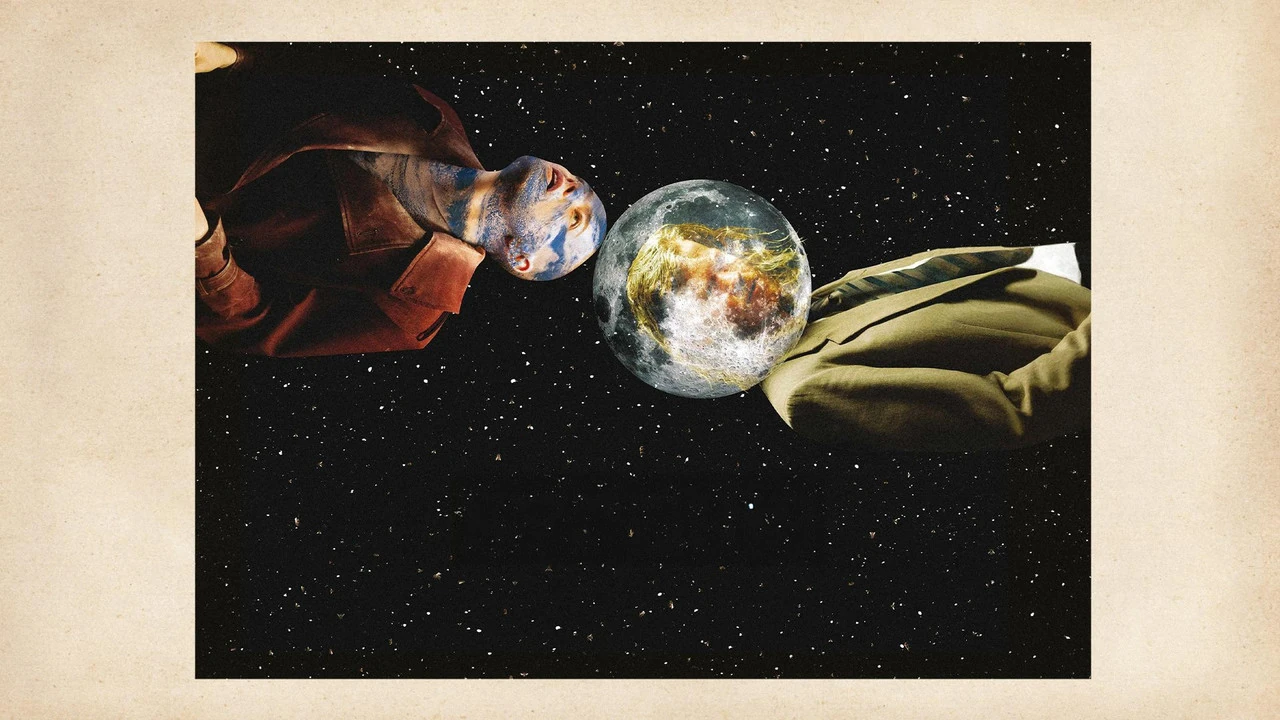 A surreal composition, blending mundane objects with an otherworldly glow, reflecting the film’s genre fusion.
“We seek monsters because the alternative—that the chaos is our own making, that the emptiness is within—is far more terrifying than any alien threat.”
Ultimately, Bugonia is poised to be a quintessential Lanthimos film: complex, challenging, and intellectually stimulating. While it will undoubtedly generate strong reactions, potentially drawing both fervent praise and sharp criticism for its unique vision and uncompromising style, its philosophical value seems undeniable. It will compel us to examine not just the absurdity of its characters’ beliefs, but the very mechanisms by which we construct our own realities, decide what is true, and choose who to trust—or fear—in a world that often feels deeply, unsettlingly alien. What mirrors will Lanthimos hold up to our modern paranoia, and how will we react to the reflections?
Where to Watch
- Peacock Premium
- Peacock Premium Plus
What’s Up? explores the philosophical depths of cinema.