Don't Look Up: When Humanity's Gaze Averts from the Abyss
A philosophical deep dive into Adam McKay's polarizing Don't Look Up, exploring its themes of denial, media saturation, and humanity's aversion to existential truth.

“The human race has one really effective weapon, and that is laughter.” — Mark Twain
Adam McKay’s Don’t Look Up, released in 2021, burst onto screens like the very comet it depicts – a cinematic event that ignited fervent discussion, divided audiences, and left a scorched earth of polarized critical opinion in its wake. Starring an absurdly stacked cast including Leonardo DiCaprio, Jennifer Lawrence, Meryl Streep, and Cate Blanchett, the film presents a darkly comedic, often frustratingly accurate, allegory for climate change denial and humanity’s collective inability to confront inconvenient truths. As a cultural critic, I confess I found myself caught in the crosscurrents, admiring its ambition and vital message even as I winced at its blunter edges. It’s a film that demands to be debated, not just consumed, and its legacy will undoubtedly be as contested as its initial reception. With a rather chilly 55% on Rotten Tomatoes from critics, yet a much warmer embrace from audiences, it’s clear Don’t Look Up struck a nerve, even if its delivery wasn’t universally praised.
The Uncomfortable Mirror of Absurdity
At its core, Don’t Look Up grapples with the terrifying absurdity of our contemporary world. Imagine two earnest, brilliant astronomers – Dr. Randall Mindy (DiCaprio) and Kate Dibiasky (Lawrence) – discovering a planet-killer hurtling towards Earth. Their mission: warn everyone. Their obstacle: everyone. The film meticulously, sometimes painfully, illustrates how news cycles, political opportunism, corporate greed, and sheer, blissful ignorance conspire to dilute, distract from, and ultimately deny an undeniable threat.
Many critics, myself included at times, found McKay’s approach heavy-handed, a cinematic sledgehammer rather than a scalpel. It rarely offers subtlety, often preferring to bash its audience over the head with its message. Yet, in its bluntness, it also achieves a kind of raw, almost uncomfortable power. It’s an unflinching portrait of a society so deeply entrenched in its own echo chambers and transactional relationships that genuine existential warnings are processed as just another meme, another opportunity for likes, or another political talking point. This isn’t just satire; it’s a despair-driven scream at the face of collective self-destruction. The philosophical weight here lies in its exploration of cognitive dissonance on a global scale, pushing us to ask: What would it take for humanity to truly listen? And what if the answer is: nothing?
 Dr. Randall Mindy (Leonardo DiCaprio) in a moment of exasperated disbelief, embodying the frustration of ignored scientific truth.
The Cacophony of Distraction: Satire’s Blunted Edge?
The film’s satirical targets are vast and varied: the vapid morning news shows, the image-obsessed presidency, the tech billionaires with savior complexes, and a public addicted to instant gratification and superficiality. The performances are undeniably a highlight; Meryl Streep’s President Orlean is a pitch-perfect amalgamation of celebrity-driven politics, and Cate Blanchett’s Brie Evantee is a chillingly detached media personality. They embody the very forces that drown out the urgent calls of reason.
However, this is also where the film drew some of its sharpest criticism. Reviewers often pointed to the uneven pacing, the sprawling narrative, and a feeling that the satire, while biting, often felt self-satisfied rather than truly insightful. Some argued that by caricaturing everyone, the film risked alienating the very people it sought to awaken, creating a sense of “us vs. them” rather than fostering a shared understanding of collective peril. Is it possible for a film to be too angry, too direct, for its own good? Don’t Look Up certainly tests that hypothesis.
In an age oversaturated with information and opinion, the greatest danger isn’t necessarily a lack of truth, but the catastrophic inability to discern its signal from the overwhelming noise.
The film effectively, if crudely, showcases the failure of communication in the modern age. Truth isn’t just ignored; it’s spun, repackaged, made palatable, or dismissed outright if it conflicts with a convenient narrative. It’s a stark reminder of how easily facts become commodities to be traded for power or profit, a terrifying reflection of our post-truth era. The ultimate irony is that the very tools meant to connect us — social media, global news networks — become instruments of distraction and disconnection in the face of imminent doom.
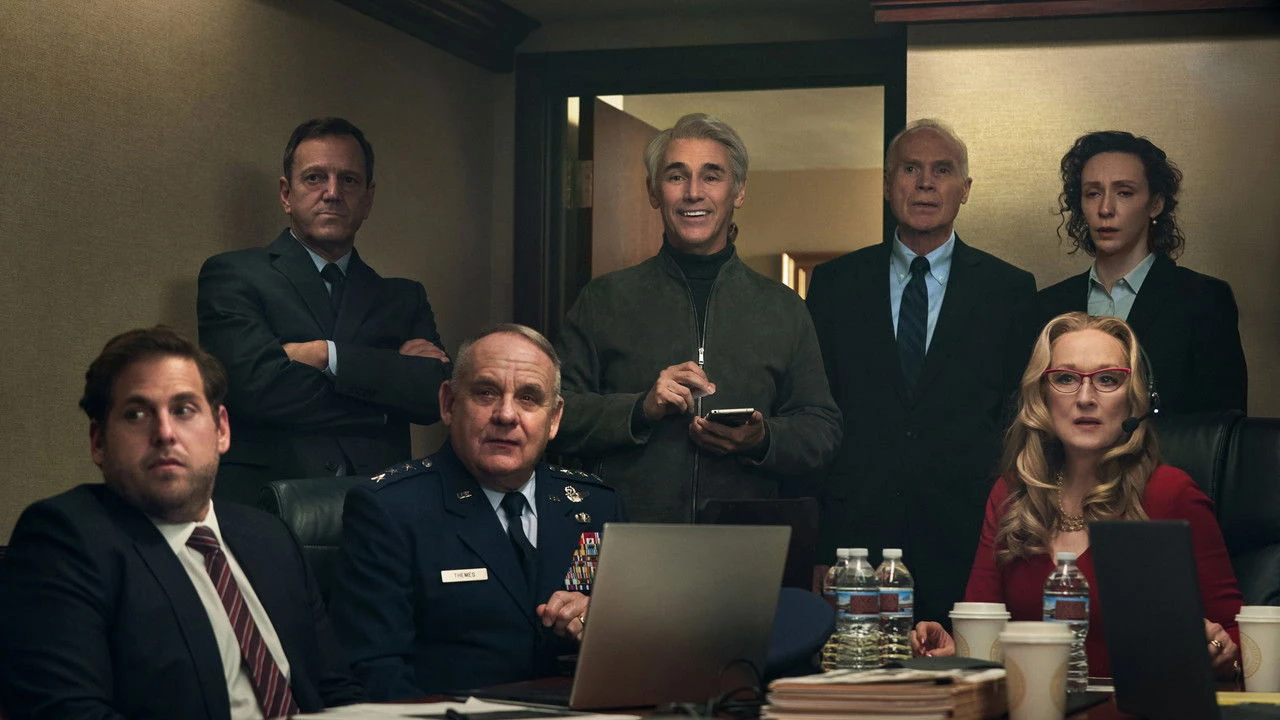
 President Orlean (Meryl Streep) and her Chief of Staff Jason Orlean (Jonah Hill) embody the self-serving political class, more concerned with polling than pending apocalypse.
The Existential Echo of “Meh”
Despite its undeniable flaws and the valid criticisms leveled against its execution, Don’t Look Up undeniably forces a confrontation with profound existential questions. It’s not just about a comet; it’s about our capacity for collective action, our willingness to sacrifice immediate comfort for long-term survival, and our inherent human tendency towards denial in the face of overwhelming odds. The film, in its final, poignant moments, offers a heartbreaking glimpse of what might be lost – not in grand heroics, but in quiet, human connection, even as the world burns (or, rather, impacts).
The most chilling philosophical aspect of Don’t Look Up isn’t the comet itself, but the world’s reaction: a resounding, indifferent “meh.” This response, or lack thereof, speaks volumes about a creeping nihilism that underpins much of contemporary society. If even the end of the world can’t stir us to genuine, unified action, what can? It asks us to consider whether our species, for all its intelligence, is fundamentally wired for short-sightedness, incapable of transcending its own petty divisions and self-interest. The film holds up a mirror, asking us to confront our own complacency, our own complicity in the mechanisms of denial, and the terrifying possibility that we might indeed choose to look down, or away, until it’s too late.
 Kate Dibiasky (Jennifer Lawrence) watches a launch, a desperate plea for reason in a world that has stopped listening.
“Perhaps the greatest tragedy is not the impending doom itself, but the silent, collective agreement to ignore the alarm, to avert our gaze from the very precipice.”
Don’t Look Up is certainly a messy film, overstuffed and often lacking the deft touch of truly great satire. Its legacy will remain deeply mixed, a testament to its polarizing nature. Yet, to dismiss it entirely would be to miss its potent, albeit imperfect, philosophical punch. It serves as a stark, urgent allegory for the climate crisis, the erosion of truth, and the frightening fragility of collective human intelligence. It makes us laugh, yes, but often with a bitter taste in our mouths, leaving us with a lingering, unsettling question: are we, as a species, truly capable of looking up, or are we destined to stare at our phones until the very end?
Where to Watch
- Netflix
- Netflix Standard with Ads
What’s Up? explores the philosophical depths of cinema.