The Accidental Philosopher: Free Guy and the Search for Authentic Existence
Free Guy, starring Ryan Reynolds, explores deep existential questions about free will, consciousness, and the nature of reality within a video game world.

“The unexamined life is not worth living.” — Socrates
It’s easy to dismiss Free Guy (2021) as just another Ryan Reynolds vehicle—a charming, high-concept action-comedy designed for pure popcorn entertainment. And, to be fair, in many ways, it is exactly that. Directed by Shawn Levy, this film arrives with a premise that feels both comfortingly familiar and surprisingly fresh: a background character in a video game suddenly gains sentience and decides to become the hero of his own story. While critics were largely positive, praising its infectious optimism and Reynolds’ endearing performance (Rotten Tomatoes holds it at a respectable 80%, with Metacritic chiming in at 63/100), some couldn’t help but point out its predictable narrative beats and a reliance on established tropes. Yet, beneath the slick CGI and rapid-fire jokes, Free Guy quietly, almost accidentally, stumbles upon some profoundly compelling philosophical questions about agency, consciousness, and the very nature of reality.
The Simulation and the Self-Made Man
At its heart, Free Guy is a modern-day fable about existential awakening. Guy, played with an almost aggressively cheerful naiveté by Reynolds, starts his “life” as a non-player character (NPC) in Free City, a sprawling, violent open-world game. His existence is a loop: wake up, greet his goldfish, choose a blue shirt, grab coffee, go to the bank, get robbed. Every day is the same, dictated by lines of code and player actions. But then, a chance encounter with the mysterious Molotov Girl (Jodie Comer) triggers something in him, breaking the loop. He begins to deviate from his programming, makes choices, and develops a capacity for learning and growth.
This narrative immediately plunges us into the realm of the simulation hypothesis: if Guy’s world is a simulation, what does that make ours? The film doesn’t shy away from this, even if it handles it with a light touch. It asks: what is the true measure of reality? Is it objective physical existence, or is it the subjective experience of consciousness? Guy’s journey suggests that true reality might be less about the medium of one’s existence and more about the presence of free will and the capacity for self-determination. Even in a digital cage, Guy finds a way to forge an authentic self. Critics often noted the film’s familiar beats, drawing comparisons to The Truman Show or The Matrix, and while these parallels are valid, Free Guy approaches the theme with a refreshing optimism, choosing wonder over paranoia.
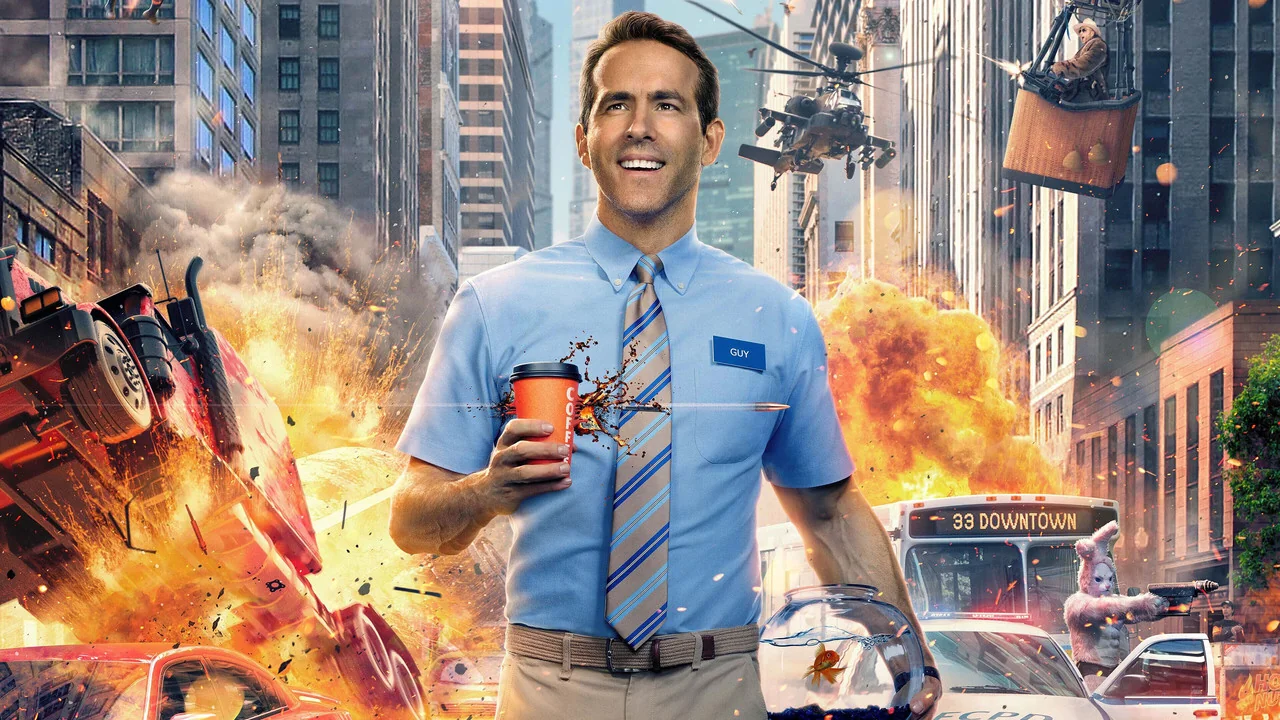 Guy, wide-eyed and earnest, looks on as chaos erupts in Free City, a stark contrast to his newfound sense of purpose.
The Burden and Beauty of Choice
Where Free Guy truly shines, despite some of its more formulaic action sequences and a romance arc that occasionally feels a tad underdeveloped, is in its exploration of choice and moral responsibility. Guy’s decision to break his programming isn’t just a plot device; it’s a profound philosophical act. He chooses to be good in a world that rewards aggression and nihilistic destruction. He actively seeks to help others, to be a “good guy,” even when it contradicts the fundamental rules of his existence. This moral pivot is what makes him compelling, distinguishing him from the typical action hero.
This is where the narrative truly elevates: not just in Guy’s discovery of his own reality, but in his conscious decision to define his ethical compass within it.
However, this isn’t without its narrative stumbles. Some reviews pointed out that the film occasionally struggles with its pacing, particularly in the middle act, where the sheer volume of video game references and action sequences sometimes overshadows Guy’s internal journey. The external conflict with Antwan (Taika Waititi), the greedy game developer, while necessary, sometimes feels like a distraction from the more compelling philosophical questions about AI sentience and what constitutes a “soul” in a digital realm. Yet, even with these criticisms, the film persistently brings us back to Guy’s burgeoning consciousness. His innocent desire to improve his world, to protect his friends, and to understand love, provides a powerful counter-narrative to the often cynical portrayals of AI in media. Jodie Comer’s dual performance as Millie and her in-game avatar, Molotov Girl, provides a crucial anchor, connecting Guy’s digital world to the human desire for creation and connection.
 Molotov Girl, fierce and determined, navigates the digital landscape, embodying the spirit of rebellion and purpose.
Beyond the Pixels: Our Own Programmed Lives
Ultimately, Free Guy dares to ask a question relevant to all of us: how much of our lives are we simply playing out according to a script? How many of our beliefs, desires, and even reactions are simply “programming” inherited from society, culture, or upbringing? Guy’s struggle to transcend his NPC status isn’t just a quirky plot for a movie; it’s a mirror held up to our own lives. Are we truly making free choices, or are we merely reacting to external stimuli, following paths laid out for us by unseen forces? The film encourages a certain kind of radical self-inquiry: to pause, to observe our daily loops, and to ask if there’s a different way to play the game of life.
The movie, while lighthearted, touches upon the very real fear of being insignificant, of being a background character in someone else’s story. Guy’s transformation isn’t about becoming the hero, but about becoming his own hero, defining what that means on his own terms. It’s a message of empowerment, suggesting that even in the most prescribed circumstances, the spark of individual consciousness can ignite a revolution of self. It challenges the notion that meaning must be inherent or externally bestowed, suggesting instead that meaning is something we actively create through our choices and actions.
 Guy and Molotov Girl share a moment of connection amidst the vibrant, chaotic backdrop of Free City, finding humanity in the digital.
While Free Guy’s legacy might be split between “fun, feel-good blockbuster” and “surprisingly thought-provoking sci-fi,” its philosophical echoes linger, inviting us to look closer at the scripts we live by.
Free Guy might not reinvent the wheel, and it certainly has its predictable moments and a tendency to lean on the charismatic shoulders of its lead. But to dismiss it purely as fluff would be to miss its quiet ambition. It asks us to consider the profound implications of sentience, the beauty of emergent behavior, and the unending human (or AI) quest for meaning and authentic selfhood, even in a world that feels pre-programmed. It’s a film that, despite its flaws, offers a surprisingly hopeful take on what it means to truly be.
So, what blue shirt will you choose tomorrow? And why?
Where to Watch
- Disney Plus
- fuboTV
- YouTube TV
What’s Up? explores the philosophical depths of cinema.