The Absurdist Symphony: Finding Meaning in Hitman's Wife's Bodyguard's Mayhem
A philosophical dive into Hitman's Wife's Bodyguard, exploring how its critical failures might inadvertently reveal deeper truths about chaos, relationships, and the search for meaning in absurdity.

“Man is condemned to be free; because once thrown into the world, he is responsible for everything he does.” — Jean-Paul Sartre
Let’s be honest, Hitman’s Wife’s Bodyguard (2021) isn’t exactly a critical darling. With a dismal 26% on Rotten Tomatoes and a Metascore of 33/100, critics largely panned Patrick Hughes’ sequel, calling it “noisy,” “chaotic,” “overstuffed,” and lamenting its thin plot and repetitive humor. Many felt it leaned too heavily on its stars’ charisma without offering much substance, a classic case of diminishing returns. And yet, for all its perceived flaws and the undeniable cacophony it unleashes, there’s something to be said for a film that embraces its own outrageousness with such unbridled gusto. Could it be that in its relentless pursuit of mayhem, this action-comedy inadvertently stumbles upon some profoundly absurdist truths about our lives, our relationships, and the very nature of existence in an increasingly chaotic world? Perhaps it’s not a film that fails at philosophical depth, but one that explores it through the lens of relentless, often exhausting, spectacle.
The Cacophony of Being: Embracing Absurdity
From the moment Michael Bryce (Ryan Reynolds) is dragged from his sabbatical by Sonia Kincaid (Salma Hayek Pinault) to rescue her husband Darius (Samuel L. Jackson), the film plunges headfirst into an unrelenting storm of gunfire, explosions, and rapid-fire insults. This isn’t just action; it’s an uninterrupted sensory assault, a relentless barrage that leaves little room for quiet contemplation. Critics often cited this as a major weakness, an exhausting experience where the volume knob seemed permanently stuck on eleven. But what if this isn’t just poor filmmaking, but a deliberate (or accidental) commentary on the existential chaos we often navigate daily?
Consider the sheer futility of Bryce’s attempts at order. He’s a highly skilled, licensed bodyguard, yet his world is constantly upended by the untamed forces of Darius and Sonia. His meticulous plans are always derailed, his sanity perpetually threatened. This mirrors the human condition in a universe that often feels indifferent, if not outright hostile, to our desire for control and meaning. The film’s exaggerated, almost cartoonish violence, devoid of real emotional consequence, can be seen as a satirical take on:
- The illusion of control: Bryce’s entire profession is about control, yet he has none.
- The relentless pace of modern life: The film rarely pauses, reflecting a world of constant stimulation and crisis.
- The search for meaning in meaninglessness: The “global plot” is almost an afterthought, a flimsy excuse for the chaos, much like our own constructed narratives to make sense of life.
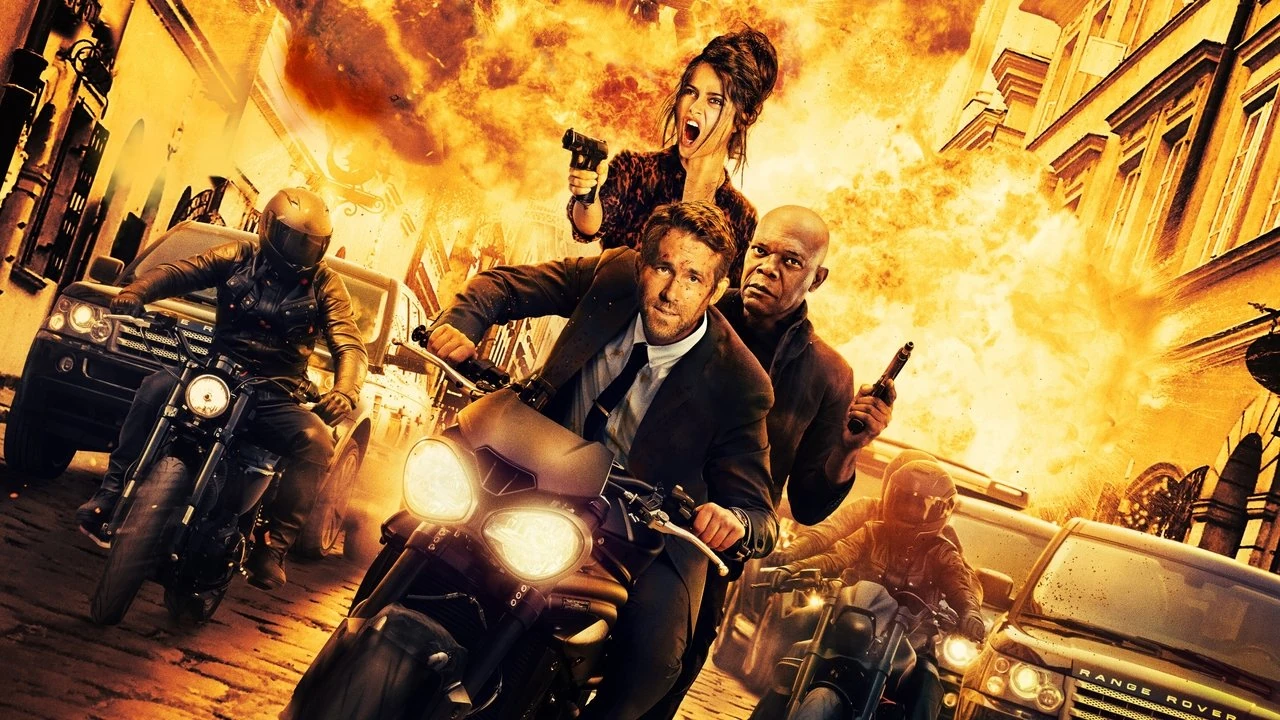 Ryan Reynolds’ Michael Bryce, perpetually exasperated, symbolizes the struggle against overwhelming chaos.
Unlikely Bonds and the Performance of Self
Despite the critical drubbing, many audience members (reflected in its more favorable IMDb and Rotten Tomatoes audience scores) found enjoyment in the undeniable chemistry between its leading trio. Reynolds, Jackson, and Hayek Pinault are forces of nature, even if the script sometimes struggles to harness them. Their characters—the meticulous bodyguard, the unpredictable hitman, and the volatile con artist—are extreme archetypes. But what happens when these archetypes are forced into unwilling interdependence?
This is where we discover the true weight of choice — not in the outcome, but in the becoming. Bryce, Darius, and Sonia, for all their bickering, become a distorted mirror of human connection, forced to choose loyalty in a world that offers little else.
The film, at its heart, is a twisted romance—not just between Darius and Sonia, but between Bryce and the Kincaids. Bryce despises them, yet he cannot escape them. He is drawn into their orbit, becoming a reluctant third wheel, a surrogate family member. This dynamic explores:
- The nature of chosen family: Even if chosen through duress, these bonds become undeniable.
- Identity through opposition: Each character defines themselves partly by their opposition to the others, yet they are incomplete without them.
- The performance of identity: Reynolds’ meta-commentary, Jackson’s swagger, and Hayek’s fire are all heightened performances. Are they their true selves, or are they playing roles that the world—and the genre—expects of them? The film’s self-awareness of its own action-comedy tropes hints at this.
It’s in these strained, often hilarious interactions that the film occasionally transcends its superficiality. The shared trauma, the mutual exasperation, and the grudging respect that develops amidst the mayhem speak to a deeper human need for connection, however dysfunctional. Even critics who found the plot lacking often conceded that the lead actors’ banter was the film’s strongest asset.
 The chaotic trio, bound by circumstance and a strange, undeniable chemistry, navigates another explosive situation.
The Catharsis of Chaos: Finding Meaning in the Mayhem
Hitman’s Wife’s Bodyguard offers a kind of catharsis through chaos. Its unrelenting pace and over-the-top violence can, for some, be a release. In a world increasingly fraught with real-life anxieties, a film where the stakes are high but the consequences are largely played for laughs (even brutal ones) provides a strange sort of escapism. But beyond mere entertainment, what does this aggressive embrace of disorder ask of us?
The character of Sonia Kincaid, in particular, is a fascinating study in unbridled agency. She is loud, violent, sexually liberated, and utterly unapologetic. She is the engine of the plot, driving the men around her with sheer force of will. In a genre often dominated by male anti-heroes, Sonia’s character, despite being part of a critically panned film, offers a powerful, if exaggerated, portrayal of a woman refusing to be confined by any societal or narrative box. She is a force of nature, almost a nihilistic sprite who finds joy in the destruction she causes, simply because it’s in her nature.
 Salma Hayek Pinault’s Sonia Kincaid, a force of nature, embodying chaotic liberation amidst the destruction.
Ultimately, Hitman’s Wife’s Bodyguard is a film that demands little from its audience in terms of intellectual engagement, yet its very excesses can provoke thought. It might not be a masterpiece, and it certainly won’t win any awards for subtlety or coherent plotting. But in its relentless, often exhausting, pursuit of explosive entertainment, it offers a peculiar lens through which to examine our own relationship with chaos, our desperate need for connection even in the most toxic forms, and the strange, often absurd, ways we find meaning—or at least a good laugh—in a world that rarely makes sense.
“Sometimes, the only way to make sense of the world is to realize it makes no sense at all, and then find something to laugh about in the wreckage.”
So, while Hitman’s Wife’s Bodyguard stands as a divisive entry in the action-comedy canon, lambasted by critics yet enjoyed by a segment of the audience, it inadvertently becomes a fascinating case study. It’s a loud, messy, and often frustrating film, yet it raises implicit questions about existential freedom, the nature of interpersonal bonds, and the peculiar catharsis of embracing the absurd. It reminds us that even in films designed for pure escapism, there can be a glimmer of reflection, a warped mirror held up to our own chaotic reality.
Where to Watch
- HBO Max
- HBO Max Amazon Channel
- Cinemax Amazon Channel
- Cinemax Apple TV Channel
What’s Up? explores the philosophical depths of cinema.