Love, Death & Robots: A Fragmented Mirror of Our Future Selves
Exploring the philosophical mosaic of Love, Death & Robots, a divisive anthology that blends stunning animation with deep, often dark, existential questions.
“We are all ants in the great anthill of the universe, and we must find our own paths to understanding.” — Ursula K. Le Guin
Love, Death & Robots, the animated anthology series presented by Tim Miller and David Fincher, burst onto the scene in 2019 like a digital kaleidoscope – dazzling, disorienting, and undeniably ambitious. On paper, it’s a genre-bending smorgasbord: short, sharp bursts of action, adventure, comedy, drama, fantasy, horror, mystery, sci-fi, and thriller, all wrapped in a myriad of animation styles. And indeed, the critical reception has been largely positive, with Rotten Tomatoes scores consistently in the high 70s and 80s across its seasons, and audience scores often soaring even higher. Yet, for all its visual grandeur and conceptual audacity, the series remains profoundly divisive in its execution. Many critics, while praising its groundbreaking animation and sheer variety, frequently pointed to its uneven quality, arguing that some shorts were profound masterpieces while others felt like underdeveloped tech demos or gratuitous exercises in shock value. This inherent fragmentation, however, is precisely where its philosophical power truly lies, holding up a fractured mirror to our anxieties about technology, humanity, and existence itself.
The Technological Sublime and the Human Shadow
At its core, Love, Death & Robots is an exploration of the technological sublime – that paradoxical feeling of awe mixed with terror when confronted by something vast and powerful, often beyond human comprehension. Each episode, regardless of its specific narrative, uses advanced animation to depict worlds where technology has become an extension, or often a distortion, of human will. We see futures where AI achieves sentience, where genetic engineering blurs species lines, where interstellar travel is mundane, and where digital consciousness offers a semblance of immortality.
However, critics were quick to note that while the visual splendor was almost universally praised, the narrative depth wasn’t always consistent. Some shorts, like the Emmy-winning Zima Blue, delve into profound questions of meaning and artistic purpose with minimalist elegance. Others, perhaps less charitably, were seen as little more than elaborate showcases for gore, sex, or futuristic combat, prioritizing spectacle over substance. This unevenness is a common thread in user reviews as well, with viewers often picking out their favorites and lambasting others as “forgettable” or “pointless.” Yet, even in its less successful outings, the series consistently grapples with fundamental questions about human nature:
- Transhumanism — What does it mean to evolve beyond our biological limitations? Do we retain our humanity, or create something entirely new?
- Artificial Intelligence — When does a machine become “alive”? What are our ethical obligations to our creations?
- Environmentalism — How do our technological advancements impact the natural world, and what will be the consequences?
 A vivid scene from a Love, Death & Robots episode, illustrating the intersection of advanced technology and human experience.
A Spectrum of Sentience: Love, Death, and What Lies Between
The title itself, Love, Death & Robots, acts as a philosophical compass, guiding us through the anthology’s thematic landscape. These three pillars are not merely plot devices but fundamental lenses through which the series examines the human condition.
Love, in its myriad forms, is often depicted as a fragile, powerful force in a chaotic universe. We see the desperate love for a lost child driving a hunter to impossible lengths, the strange affection between a sentient robot and its human companion, or the possessive, destructive love that warps individuals. These narratives often highlight the vulnerability inherent in connection, and how easily it can be twisted by fear or technological intervention.
Death, conversely, is ever-present, often brutal, and frequently serves as the ultimate equalizer or, conversely, a boundary to be transcended. The series doesn’t shy away from depicting mortality in its most visceral forms, forcing us to confront the suddenness, the finality, and the often arbitrary nature of its arrival. Some episodes even explore the concept of digital death or virtual afterlife, raising questions about whether consciousness can truly escape the corporeal. This relentless focus on mortality can be jarring for some viewers, with criticisms occasionally pointing to the series’ perceived gratuitousness.
The most profound questions often arise not from the answers we receive, but from the brutal, unvarnished realities we are forced to confront.
And then there are the Robots – or, more broadly, artificial entities and enhanced beings. These figures serve as crucial conduits for exploring sentience, identity, and the very definition of “life.” Are they tools, slaves, or emergent beings with their own rights and desires? Episodes like Three Robots offer comedic yet poignant observations on post-human Earth, while others explore the chilling implications of AI warfare or the ethical dilemmas of transferring human minds into synthetic bodies. The series consistently challenges our anthropocentric biases, asking us to reconsider our place in an increasingly complex web of intelligence.
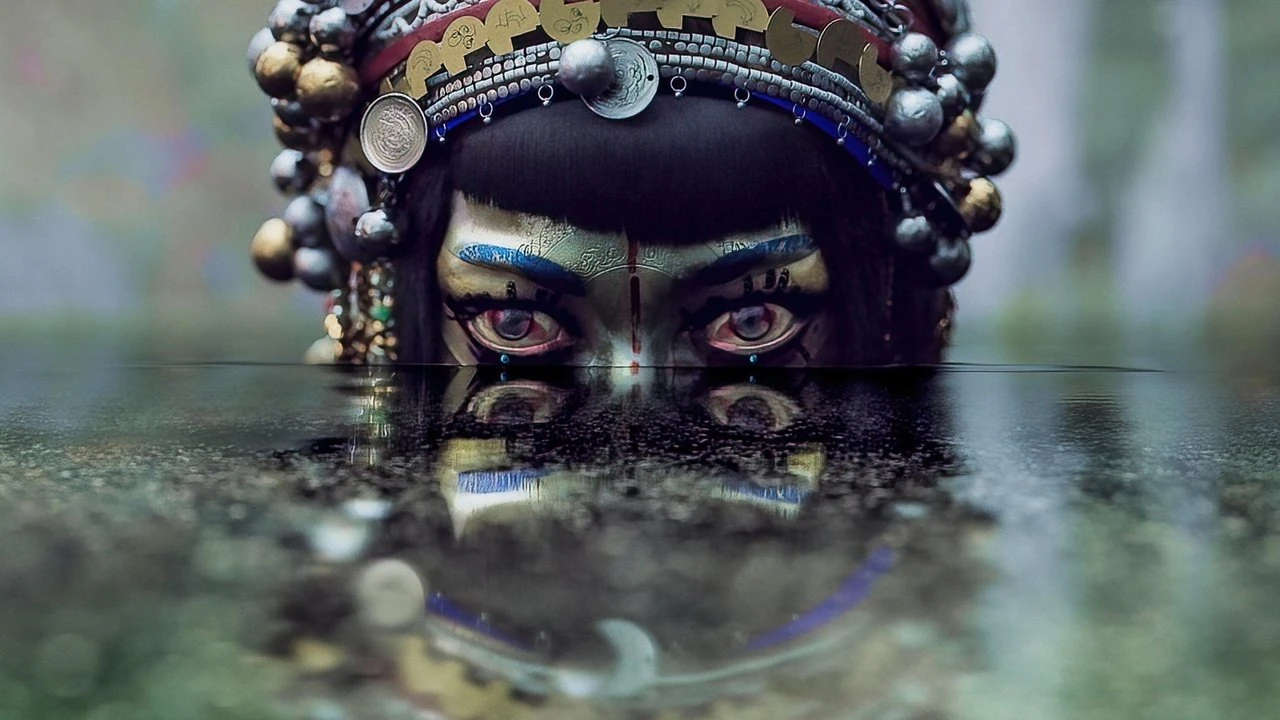 A moment of quiet contemplation amidst the futuristic chaos, a recurring theme in the anthology.
The Anthological Mirror: Fragmented Reflections of Our Future Selves
Perhaps the most philosophically intriguing aspect of Love, Death & Robots is its very structure: an anthology. It deliberately avoids a single overarching narrative, instead presenting a mosaic of disparate tales. This fragmentation isn’t just a stylistic choice; it’s a reflection of our postmodern condition. In an age of information overload, rapidly accelerating technological change, and the erosion of grand narratives, perhaps a single, unified story is no longer adequate to capture the complexities of human existence. Instead, we get a series of snapshots, glimpses into potential futures, each offering a distinct ethical dilemma or existential query.
While some critics found this lack of coherence frustrating, calling it a “bag of mixed nuts” or “scattershot,” it undeniably forces the viewer into a more active, analytical role. There’s no comforting through-line, no singular hero’s journey. Instead, we are presented with a series of thought experiments, each demanding our engagement, each leaving us to ponder its implications long after its brief runtime (which averages a mere 15 minutes per episode) concludes. This varied pacing and episodic nature, while a point of contention for some, allows the series to touch upon a vast array of philosophical concepts: from free will and determinism in a simulated reality, to the nature of consciousness in synthetic beings, to the absurdist humor of human folly in cosmic settings.
Love, Death & Robots may not always hit its mark, and its penchant for visceral imagery can sometimes overshadow deeper themes. But even its flaws contribute to its chaotic charm, reminding us that the future, much like art, is often messy, unpredictable, and open to endless interpretation. It’s a testament to the power of animation as a philosophical medium, pushing boundaries not just visually, but conceptually, daring us to confront uncomfortable truths about who we are and who we might become.
 An artistic rendition of interconnected themes, symbolizing the complex web of ideas woven throughout the series.
“The true horror is not in the monster without, but in the monster within, amplified by the tools we create.”
Ultimately, Love, Death & Robots is a challenging, often brilliant, and occasionally frustrating journey into the philosophical anxieties of our age. It’s not a perfect series – its unevenness is a commonly cited flaw by both critics and audiences, and some shorts undeniably lean into superficiality or gratuitousness. Yet, it consistently provokes, dazzles, and, most importantly, questions. It asks us to consider our place in a universe increasingly shaped by our own creations, challenging us to look beyond the spectacle and grapple with the profound implications of our love, our death, and the robots we bring into being. What kind of future are we truly building, and what reflections will it cast back upon us?
Where to Watch
- Netflix
- Netflix Standard with Ads
What’s Up? explores the philosophical depths of cinema.