Maharaja's Labyrinth: When Justice Becomes a Personal Myth
Exploring Maharaja's complex narrative, the nature of vengeance, and the subjective value of loss, dissecting its philosophical depth.

“We are condemned to be free, but what if freedom means choosing a path born of unbearable loss?” — Jean-Paul Sartre (adapted)
Nithilan Saminathan’s Maharaja (2024), starring Vijay Sethupathi and Anurag Kashyap, arrived with a quiet intensity that quickly resonated with audiences and critics alike. Marketed as an action-crime thriller, it’s a film that, at first glance, seems to follow a familiar trajectory of vengeance. Yet, beneath its carefully constructed non-linear narrative and visceral action, Maharaja delves into far more profound territories, forcing us to confront the subjectivity of loss, the elusiveness of truth, and the very definition of justice. It’s a film that has been largely lauded for its cleverness and Sethupathi’s compelling performance, earning high praise on IMDb and a strong showing with critics. But like any ambitious narrative, it isn’t without its narrative tightropes, sometimes testing our patience before delivering its potent emotional punch.
The Unbearable Weight of Absence: Lakshmi and the Shifting Sands of Truth
The film opens with a deceptively simple premise: a barber, Maharaja (Vijay Sethupathi), reports a burglary, cryptically stating that his “Lakshmi” has been taken. The police, initially dismissive, are left to grapple with whether this “Lakshmi” is a person or an object, an ambiguity that quickly becomes the narrative’s beating heart. This central mystery isn’t just a plot device; it’s a profound exploration of epistemology—the philosophical study of knowledge itself. How do we know what we know? How are our perceptions shaped by limited information, by assumptions, and by the very language we use?
Critics widely praised this narrative ingenuity, noting how effectively Maharaja keeps the audience guessing, aligning us with the police’s initial confusion. However, some viewers, particularly those accustomed to more straightforward storytelling, found the initial pacing deliberate, almost frustratingly so, as the film withholds crucial information. It’s a narrative gamble that pays off handsomely by the third act, but one that requires a degree of patience. The genius lies in how this structural choice mirrors the film’s philosophical core: true understanding is rarely immediate; it’s often built brick by painful brick. Maharaja’s unwavering focus on finding “Lakshmi” transforms her from a mere plot point into a symbol of something deeply personal and invaluable, challenging the audience to question their own preconceived notions of worth and loss.
 The enigmatic presence of “Lakshmi” looms over every scene, a silent question mark in Maharaja’s determined quest.
The Everyman’s Descent: Justice, Retribution, and Moral Grey
Vijay Sethupathi’s portrayal of Maharaja is nothing short of captivating. He embodies the quiet desperation of an ordinary man pushed to extraordinary lengths. This isn’t the bombastic heroism of a typical action star; it’s the raw, unpolished resolve of someone whose world has been irrevocably shattered. His journey forces us to grapple with the complex interplay between vengeance and justice. Is what Maharaja seeks true justice, or is it a primal form of retribution, born of a wound too deep for legal remedies?
Maharaja doesn’t offer easy answers; instead, it plunges us into the morally ambiguous territory where the lines between right and wrong blur, forcing us to confront the dark elasticity of human will when confronted with unbearable pain.
The film introduces a formidable antagonist in Anurag Kashyap’s character, a figure who represents a cold, almost casual malevolence. The contrast between Maharaja’s deeply personal, emotionally charged quest and the villain’s detached cruelty highlights the vast spectrum of human experience and depravity. While Maharaja has been overwhelmingly lauded for its emotional impact and clever twists, a few critiques have pointed to moments where the narrative might slightly strain credulity in its effort to set up the grand reveal, or perhaps where the violence, while justified by the plot, treads a fine line for some viewers. Yet, even these minor quibbles underscore the film’s commitment to portraying the visceral consequences of its themes. It asks: when the law falls short, or simply fails to understand the true nature of a loss, what recourse does an individual have? And what does that choice cost them, and us, as observers?
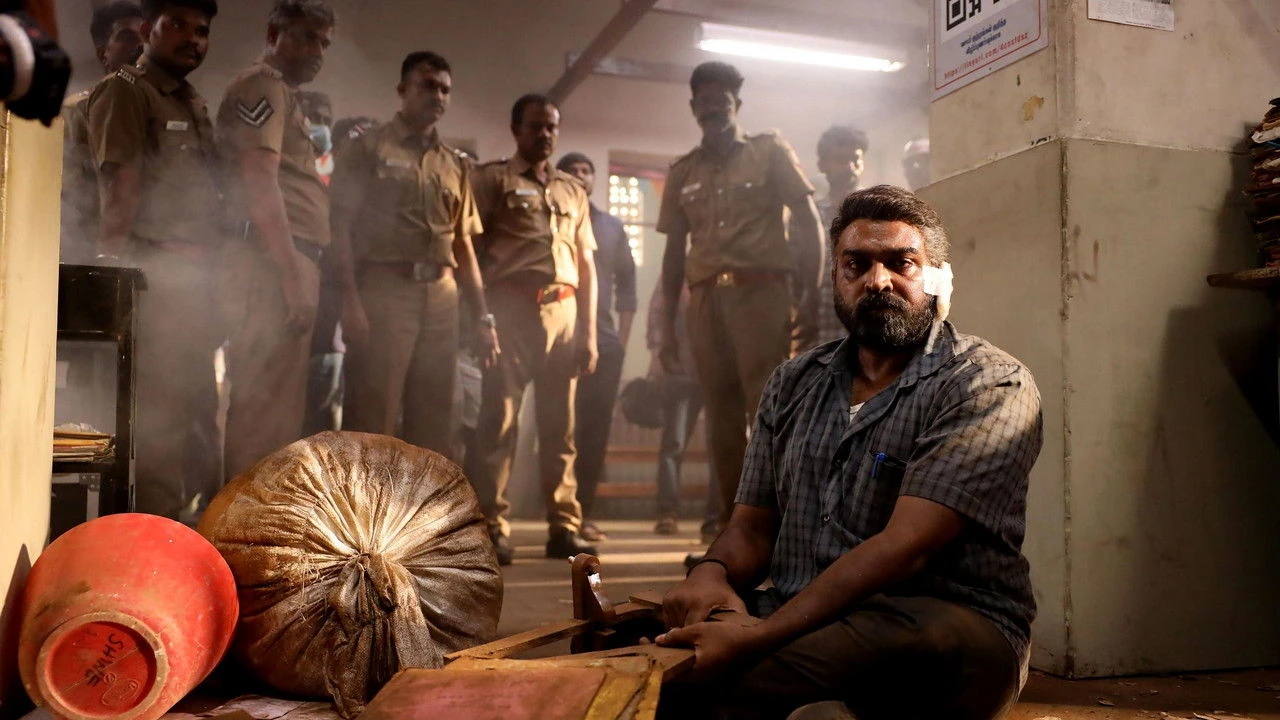 Maharaja, a picture of quiet resolve, confronts the depths of his loss and the path he chooses to walk.
Beyond the Twists: Memory, Identity, and the Scars We Carry
As the layers of Maharaja’s mystery are peeled back, the film transcends its genre trappings to become a meditation on memory, identity, and the indelible scars of trauma. The eventual revelation of what “Lakshmi” truly represents isn’t just a clever twist; it’s an emotional gut-punch that recontextualizes every scene that came before. It speaks to the profound truth that what we value, what we lose, and how we react to that loss, fundamentally shapes who we are. Maharaja’s identity becomes inextricably linked to “Lakshmi,” a symbol of his past, his purpose, and his very being.
The film skillfully navigates the psychological landscape of grief, illustrating how an individual can be utterly consumed by a single, all-encompassing objective. It’s an exploration of human resilience, yes, but also of the terrifying tunnel vision that profound suffering can induce. What makes Maharaja resonate philosophically is its ability to tap into a universal human fear: the fear of losing something so precious, so deeply personal, that its absence makes life feel meaningless. It challenges us to consider what our own “Lakshmi” might be – that invaluable, irreplaceable element that defines our existence, and what we might be capable of if it were taken from us.
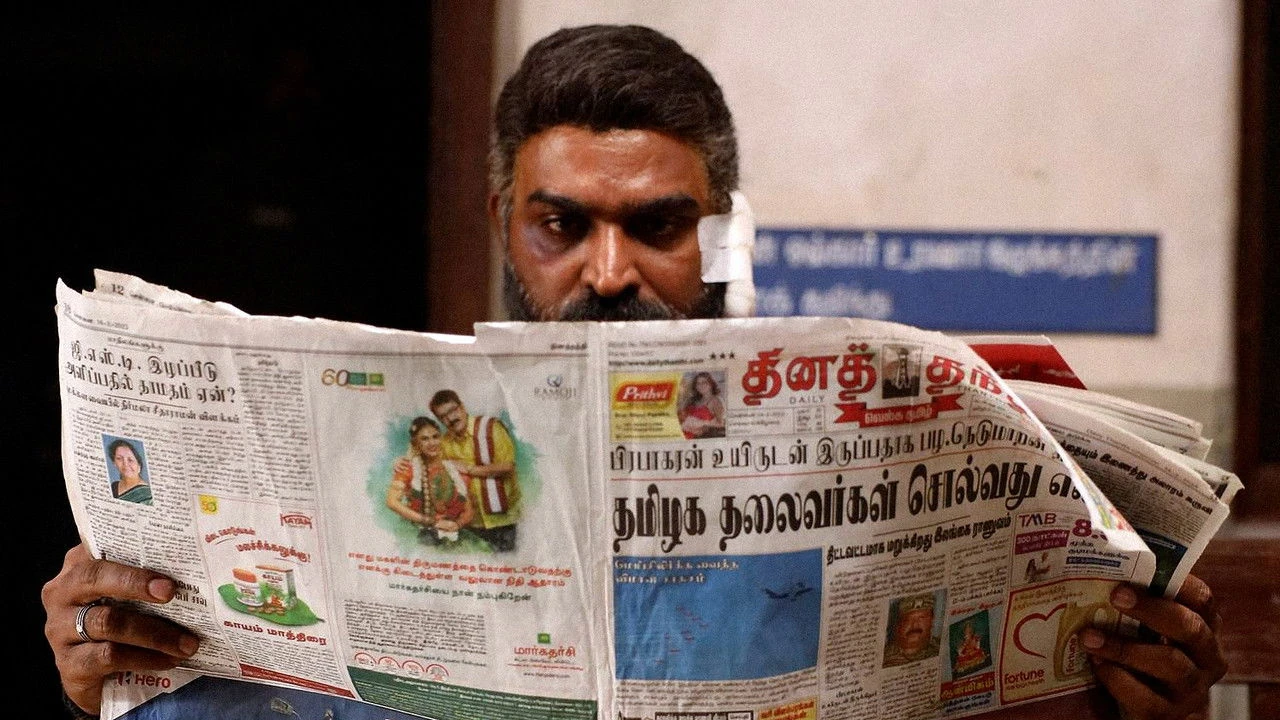 The weight of his past and the path of his future converge in Maharaja’s haunted gaze.
The enduring question Maharaja leaves us with isn’t just about the efficacy of revenge, but the very nature of what makes us human – our capacity for love, for loss, and for the terrifying, beautiful lengths we’ll go to protect what we hold dear, even if it means tearing ourselves apart in the process.
Ultimately, Maharaja is a remarkably impactful film. While some might find its narrative structure occasionally demanding or its emotional manipulation potent, these are small prices to pay for a story that genuinely provokes thought and feeling. It’s a reminder that even within the confines of a genre thriller, there lies fertile ground for existential inquiry, urging us to look beyond the surface and into the intricate, often painful, tapestry of the human spirit. What does our own “Lakshmi” truly represent, and how much would we sacrifice for it?
Where to Watch
- Netflix
- Netflix Standard with Ads
What’s Up? explores the philosophical depths of cinema.