The Genesis of Tyranny: Attack of the Clones and the Allure of Order
A philosophical deep dive into Star Wars: Episode II – Attack of the Clones, exploring political manipulation, the seduction of authoritarianism, and Anakin's tragic fall.

“The road to hell is paved with good intentions.” — Saint Bernard of Clairvaux
In the vast cosmic tapestry of Star Wars, Episode II - Attack of the Clones is often seen as a bridge, a narrative necessary to connect the vibrant Republic to the tyrannical Empire. Yet, beneath its often-maligned dialogue and CGI spectacle, lies a profoundly disturbing philosophical treatise on the fragility of freedom, the seductive call of order, and the incremental, almost imperceptible steps towards totalitarianism. George Lucas’s 2002 epic is not merely a space opera; it is a chilling political allegory, a cautionary tale echoing through history and resonating with a timeless human susceptibility to fear and the promise of a strong hand. It asks us to confront the uncomfortable truth that even the most benevolent intentions can forge the chains of oppression, and that the seeds of tyranny are often sown in the fertile ground of perceived chaos.
The Republic’s Rupture: A Study in Democratic Erosion
Attack of the Clones unfolds amidst a galactic crisis: Senator Padmé Amidala, an ardent voice for peace, faces assassination attempts, and the Separatist movement, led by the charismatic Count Dooku, threatens to tear the Republic asunder. But this political machination is more than mere plot; it is a masterclass in the insidious erosion of democratic principles. Chancellor Palpatine, a figure of seemingly benign authority, expertly manipulates fear, orchestrating events that lead to the granting of “emergency powers.” This is the classic playbook of the authoritarian creep, where crises are manufactured or exacerbated to justify the curtailment of liberties and the concentration of power.
The film meticulously charts the path to a preemptive war, framed as a necessary evil to preserve peace. The sudden, enigmatic appearance of a massive clone army, ordered in secret by a deceased Jedi Master, highlights the dangers of unchecked institutional power and the ease with which a society can be steered towards conflict under false pretenses. The Jedi, guardians of peace, find themselves unwittingly complicit, thrust into command of an army they did not request, fighting a war whose origins are shrouded in deceit. This isn’t just a political thriller; it’s a stark examination of how a moral compromise, once accepted, can set in motion an unstoppable cascade towards moral bankruptcy.
Key themes to explore:
- Political Manipulation — the art of manufacturing consent and exploiting fear for power.
- Democratic Erosion — how a free society can willingly surrender its liberties for perceived security.
- The Justification of War — the dangerous rhetoric surrounding preemptive action and “necessary evils.”
 The serene beauty of Naboo contrasts sharply with the brewing storm of galactic conflict and political intrigue.
Anakin’s Descent: The Ethics of Attachment and Control
While the galaxy descends into war, the true tragedy of Attack of the Clones unfolds in the nascent darkness within Anakin Skywalker. His character arc is a poignant exploration of the human condition, grappling with attachment, fear, and the yearning for control. Anakin’s forbidden love for Padmé, while seemingly romantic, becomes a conduit for his darkest impulses. His fear of losing her, a fear amplified by his mother’s tragic death, is the existential fuel for his desire to circumvent death itself, to gain power over life and fate. This is not merely a personal flaw; it is a universal human struggle against vulnerability and impermanence.
This is where we discover the true weight of choice — not in the outcome, but in the becoming.
The Jedi Order, with its austere philosophy of non-attachment, inadvertently contributes to Anakin’s internal turmoil. By forbidding deep personal bonds, they push Anakin’s passionate nature into the shadows, allowing it to fester and grow into a destructive force. His violent outburst against the Tusken Raiders, a desperate act of vengeance for his mother’s death, is a chilling precursor to his later atrocities. It reveals the ease with which grief can transmute into rage, and how the inability to process loss can lead to a desperate grasp for power, believing it will prevent future suffering. Obi-Wan Kenobi, ever the pragmatic and loyal Jedi, struggles to mentor his headstrong apprentice, emblematic of the Jedi Order’s institutional blindness to the very emotional forces that Palpatine so expertly exploits. The film forces us to question the ethics of dogma and the consequences of suppressing natural human emotions, especially in those destined for immense power.
 The tumultuous sky mirrors Anakin’s internal struggle, hinting at the darkness beginning to consume him.
Beyond the Surface: The Metaphysics of Perception and Fate
Beyond the political machinations and character studies, Attack of the Clones delves into metaphysical questions concerning perception, fate, and the nature of evil. The Jedi, for all their wisdom and connection to the Force, are astonishingly blind to the Sith Lord operating directly beneath their noses. This speaks to the dangers of complacency and the limitations of even the most enlightened institutions when confronted with a truly cunning and patient adversary. Their reliance on prophecy and their rigid adherence to tradition make them vulnerable, unable to perceive the subtle shifts in the Force or the growing darkness.
The film also toys with the idea of predestination versus free will. Anakin is prophesied to bring balance to the Force, yet his choices continually steer him towards the dark side. Is his fall inevitable, a tragic fulfillment of a larger cosmic design? Or is it a series of individual choices, each one pushing him further down a path he chooses? Attack of the Clones leaves this question tantalizingly open, suggesting that even within a grand narrative of destiny, personal responsibility remains paramount. The very existence of the clone army, a pre-made instrument of war, raises questions about agency and the manufacturing of destiny, both for the clones themselves and for the galaxy they are unwittingly forced to conquer. The film posits that true evil often hides in plain sight, masquerading as necessity, and that the greatest threats emerge not from outright monsters, but from the slow, deliberate corruption of ideals.
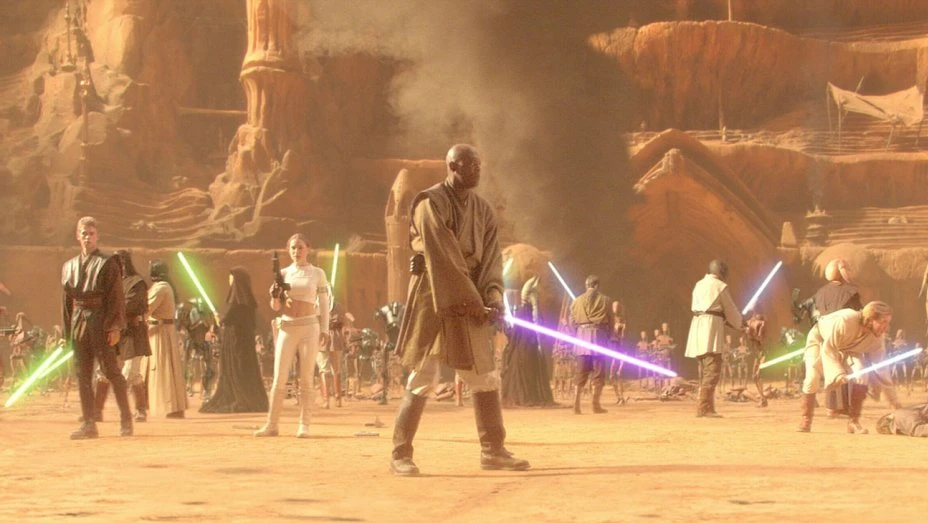 The spectacle of battle on Geonosis masks the profound tragedy of a galaxy blindly hurtling towards its own undoing.
“Power is not a means; it is an end. One does not establish a dictatorship in order to safeguard a revolution; one makes the revolution in order to establish the dictatorship.” — George Orwell, Nineteen Eighty-Four
Star Wars: Episode II - Attack of the Clones serves as a grim mirror, reflecting the ease with which societies can be manipulated and individuals corrupted. It is a cinematic essay on how fear, when expertly wielded, can dismantle democratic structures, and how the noble pursuit of order can pave the way for an absolute tyranny. The film’s lasting philosophical resonance lies not just in its portrayal of Anakin’s tragic fall, but in its chilling depiction of a galactic populace willingly, if unknowingly, marching towards its own enslavement, all under the banner of security and peace. It forces us to ask: What price are we willing to pay for order, and at what point does the cure become more terrifying than the disease?
Where to Watch
- Disney Plus
What’s Up? explores the philosophical depths of cinema.