The Trophy and the Void: Unpacking Student of the Year 2's Existential Echoes
Exploring the philosophical undercurrents of Student of the Year 2, a film largely panned by critics, examining themes of validation, authenticity, and the pursuit of manufactured success.

“We are condemned to be free; every choice is a burden, and every aspiration a self-definition.” — Jean-Paul Sartre (adapted)
Let’s be upfront: Student of the Year 2, Punit Malhotra’s 2019 follow-up to the popular Karan Johar original, landed with a resounding thud among critics and a significant portion of the audience. With a dismal 6% on Rotten Tomatoes and a 2.2/10 user score on IMDb, it’s fair to say the film struggled to find its footing, often lambasted for its generic plot, superficial characters, and an over-reliance on gloss without substance. It’s a movie many would dismiss as pure, unadulterated escapism, lacking any real depth. And truthfully, it is an exercise in maximalist spectacle, sometimes feeling more like an extended music video than a cohesive narrative. Yet, even in its most criticized moments, a film — any film — can inadvertently hold a mirror to our shared human experiences, forcing us to ask: what lies beneath the veneer of manufactured perfection?
The Spectacle of Striving: Validation in a Vacuum
Student of the Year 2 drops us into a world of hyper-stylized college life, where competitive dance-offs and kabaddi matches seem to take precedence over actual academics. Our protagonist, Rohan Sachdev (Tiger Shroff), follows his childhood sweetheart, Mridula Chawla (Tara Sutaria), to the elite St. Teresa’s, only to find himself embroiled in a predictable underdog tale against the privileged Manav Singh Randhawa (Aditya Seal) and navigating the affections of the fiery Shreya Randhawa (Ananya Panday). Critics rightly pointed out the film’s formulaic nature, its thin character development, and its often ludicrous depiction of collegiate existence. The world presented is less a university and more a vibrant, sun-drenched playground for the beautiful and the wealthy.
But what if we view this glossy, unrealistic setting not as a flaw in realism, but as a deliberate hyperreality, a simulacrum of aspiration? The coveted “Student of the Year” trophy becomes less about academic achievement and more about an abstract ideal of belonging and validation. Rohan’s entire journey, from his humble beginnings to his relentless pursuit of the title, isn’t just a quest for a shiny cup; it’s an existential striving for recognition within a system that values external markers of success above all else. He wants to prove himself, not necessarily to himself, but to a world that seems to demand a certain kind of ‘winner.’ This chase, while narratively thin, echoes our own societal pressures to achieve, to perform, to win, often without truly questioning the value of the prize itself.
- Manufactured Ideals: The “Student of the Year” trophy as a symbol of an idealized, often unattainable, self.
- External Validation: The core drive for many characters, reflecting a human need to be seen and accepted.
- The Absurdity of Competition: When the stakes feel so fabricated, what does it say about our real-world obsessions with comparative success?
 Tiger Shroff’s character, Rohan, caught in a moment of determined striving, symbolizing the pursuit of an idealized identity.
The Illusion of Authenticity and the Social Mask
One of the most frequent criticisms leveled against Student of the Year 2 was its perceived lack of depth in characters and performances. Reviewers often found the portrayals bland, the emotions forced, and the new talents, Ananya Panday and Tara Sutaria, struggling to make a significant impact amidst the dazzling production. Tiger Shroff, while undeniably excelling in action and dance sequences, was often critiqued for a limited emotional range.
From a philosophical standpoint, this isn’t just a critique of acting; it can be seen as an unintended commentary on authenticity itself. The characters in Student of the Year 2 often feel less like individuals and more like archetypes, each performing a role: the underdog with a heart of gold, the entitled bully, the spirited newcomer, the unattainable crush. They wear social masks, not just for each other, but for the audience. Their struggles, their joys, their rivalries — they all feel performed, part of a grand spectacle.
The film, despite its narrative shortcomings, forces us to question: are we, too, constantly performing versions of ourselves, chasing an ideal that isn’t truly our own? Is the struggle for authenticity an inherent part of the human condition, even in the most superficial of narratives?
This continuous performance, this striving to fit into predetermined roles, can be seen as an exploration of our own anxieties about self-presentation. How much of our daily lives are spent curating an image, striving for an external validation that might not align with our true selves? The film’s failing to deliver authentic characters inadvertently highlights how difficult and complex true authenticity can be, especially when surrounded by societal pressures to conform to a certain ideal of “success” or “coolness.”
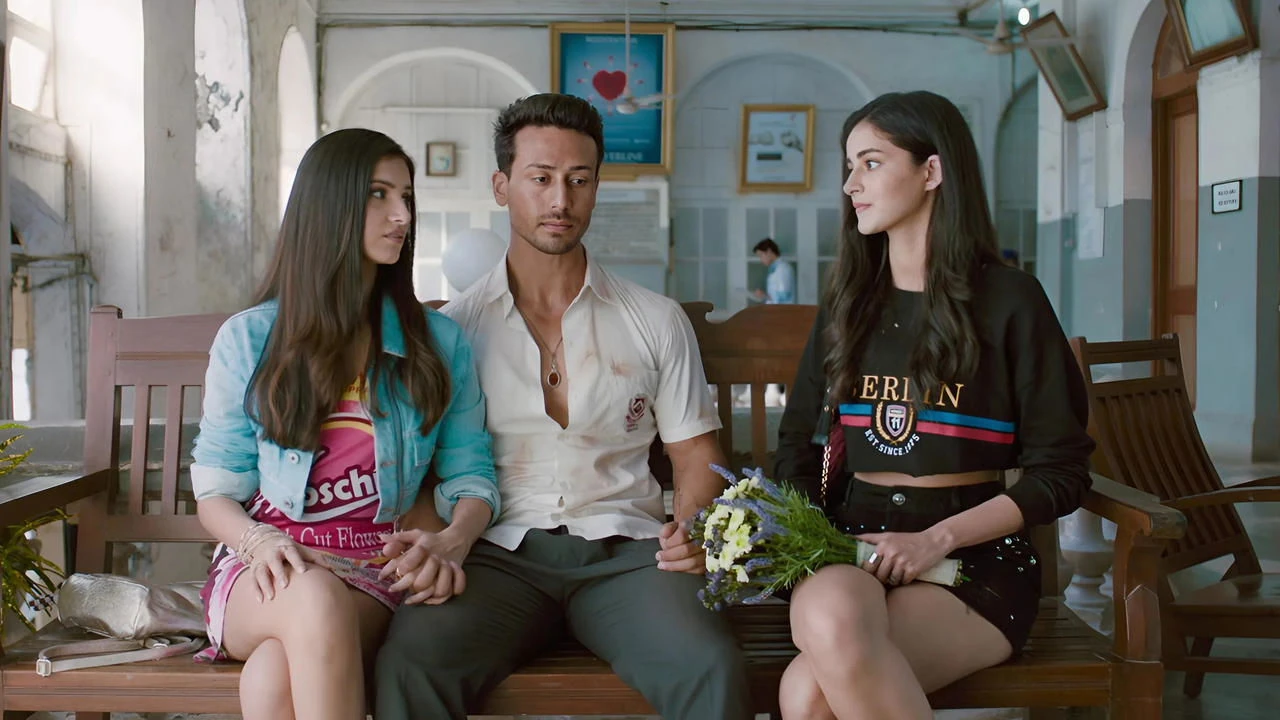 The cast in a vibrant, almost theatrical setting, emphasizing the performative nature of their roles and the film’s aesthetic.
Flawed Narratives, Lingering Questions
Beyond the surface-level criticisms of uneven pacing, plot holes, and a predictable script, Student of the Year 2 still offers a curious lens through which to view certain existential questions. The movie’s relentless optimism, even in the face of setbacks, often feels at odds with the genuine struggles of life. It’s a world where problems are usually solved with a dance battle or a heroic feat of kabaddi. Yet, this very escapism, this refusal to engage with genuine conflict, can be profoundly telling.
Perhaps the film, in its very escapism, reflects a collective yearning for simpler solutions, for a world where good triumphs easily, and external markers define our worth. It’s a fantasy of clear-cut good and evil, of easily identifiable heroes and villains, a stark contrast to the moral ambiguities and existential anxieties that define much of our real existence. The film asks us, perhaps unintentionally: are we truly content with narratives that gloss over complexity, or does the very act of consuming such content reveal a deeper desire for uncomplicated triumph?
Existential truth often lurks in the shadows of the superficial, reminding us that even in the most dazzling distractions, the human quest for meaning persists, however unaddressed.
This desire for an uncomplicated narrative, for an easy win, highlights a fundamental human tension: the desire for an ordered, predictable universe versus the chaotic, uncertain reality we inhabit. Student of the Year 2 offers the former, a comforting delusion that, when examined, reveals our profound longing for control and clear purpose.
 Ananya Panday and Tara Sutaria’s characters, embodying the youthful exuberance and competition within the film’s stylized world.
While Student of the Year 2 may never be celebrated for its critical acclaim or narrative depth, its very existence as a cultural artifact compels us to reflect. It’s a stark reminder that even the most commercially-driven, critically-panned works can, however inadvertently, shed light on our collective desires, our anxieties about validation, and the sometimes-absurd pursuit of manufactured success. The film’s legacy, therefore, isn’t just one of cinematic failure, but a philosophical prompt to scrutinize what we truly value.
In a world increasingly driven by optics, social media validation, and the relentless pursuit of curated perfection, perhaps Student of the Year 2, with all its glitter and superficiality, inadvertently holds up a funhouse mirror. It asks us: what trophy are you chasing, and what does it truly mean to win?
Where to Watch
- Netflix
- Amazon Prime Video
- Netflix Standard with Ads
- Amazon Prime Video with Ads
What’s Up? explores the philosophical depths of cinema.